

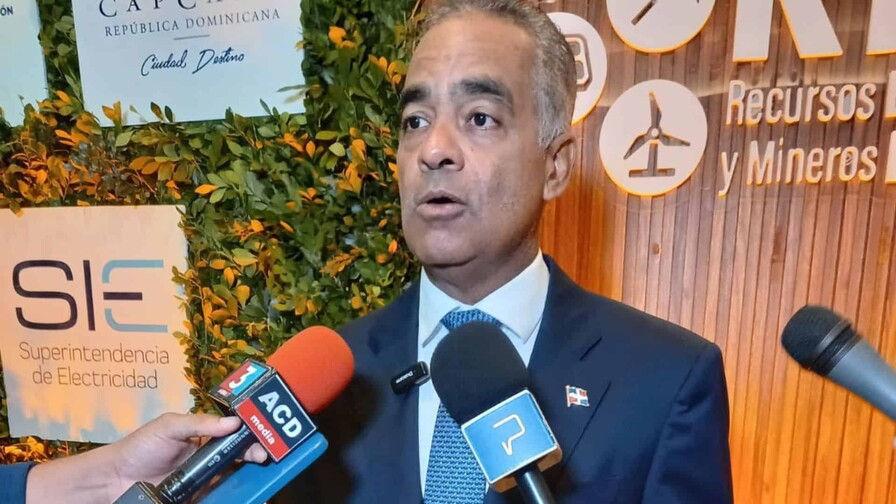
The Minister of Energy and Mines, Joel Santos, highlighted that in 2020 the installed capacity of non-conventional renewable energies in the Dominican Republic was 555 megawatts and that it currently exceeds 2,000 megawatts thanks to 38 solar and wind projects in operation.
During his participation in the sixth edition of the REM event: Energy and Mining Resources, organized by Factor de Éxito magazine under the slogan “Connecting Infrastructure, Energy and Mining for Competitiveness 2030”, he added that another 25 projects are under development and will contribute at least 2,000 additional megawatts by 2028.
According to Santos, the official goal is to reach 30% of renewable energy injected into the electricity system and foresees the country reaching 50% in the first years of the next decade if energy storage systems are strengthened.
He went on to explain that the Government is encouraging moves to incorporate between 800 megawatts and one gigawatt of storage capacity to stabilize the electricity system and make better use of renewable energy.
He also mentioned the Hostos project, a private initiative aimed at electrically interconnecting the Dominican Republic with Puerto Rico through a submarine cable, which could come into operation between 2031 and 2032, if all goes to schedule, even allowing energy to be exported to the other island.
Middle East war poses energy challenge
Santos said that one of the main challenges facing the Dominican Republic because of the ongoing Middle East conflict is to continue diversifying its energy matrix to reduce dependence on fossil fuels.
He indicated that the Government has emphasized developing renewable energies, a strategy that already allows about 25% of the country’s energy to come from renewable sources.
He said that this energy diversification has contributed to the fact that the population has not felt the impact of the increase in international energy costs more intensely.
He also acknowledged that subsidizing the electricity sector continues to be a challenge, although he affirmed that the Government is working to make the system more efficient through investments in distribution and transmission networks.
The official reiterated that both the energy and mining sectors are fundamental pillars for the Dominican economy, especially at a time when world economies are facing tensions and volatility.
In the case of mining, he pointed out that its contribution is key to strengthening the influx of foreign currency and maintaining the country’s economic balance.
More thermoelectric megawatts
Santos indicated that one of the main changes in the world economy is that the energy sector can no longer grow at the same pace as the economy, and it must move forward to guarantee future investments.
He explained that the Dominican Republic hopes to double the size of its economy by 2036 and that this will force an expansion of energy capacity before new industries with high electricity consumption arrive, such as data centers, semiconductors and mining projects.
The minister stressed that the government’s strategy has been to facilitate private investments to increase electricity generation and revealed that the country plans to add more than 2,000 megawatts of thermoelectric generation by 2028.
Minerals account for more than $2.6 billion
In terms of mining, Santos defended the sector’s contribution to the Dominican economy and recalled that minerals represent the country’s main export product, worth more than 2,600 million dollars.
The Minister said that modern mining has changed radically and that it currently depends on high levels of technology and energy consumption.
He also acknowledged the communicational challenge of explaining the impact of modern mining to the population and dismantling negative perceptions about mining.
Santos pointed out that the Government is working on modifications to mining and energy legislation to update regulations given the technological, environmental and social changes.
He also defended the role of mining as a countercyclical sector, saying that it helps sustain the economy in times of international crises due to the increase in metal prices.
He also affirmed that, in 2024, mining revenues made it possible to offset part of the government’s fiscal needs, after going from 18,000 million pesos to 45,000 million pesos.
The minister said that economic diversification is one of the main strengths of the Dominican Republic and called for continuing to promote an energy sector capable of anticipating future needs and mining that contributes to economic growth while respecting the environment and benefiting communities.
Held at the Intercontinental Hotel in Santo Domingo, the event was also attended by Jon Macías, an international specialist in sustainability and decarbonization; Mónica Infante, general manager of Manzanillo Gas & Power; Roberto Herrera; Germán Pujol, director of engineering and marketing at CEPM; Roberto Torres, general manager for the Caribbean region of Schneider Electric; Óscar San Martín, general manager of CEPM; Tony Da Silva Romero, consultant; Raniero Cassoñi, political scientist; and Andrés Astacio, superintendent of Electricity.
Source:


