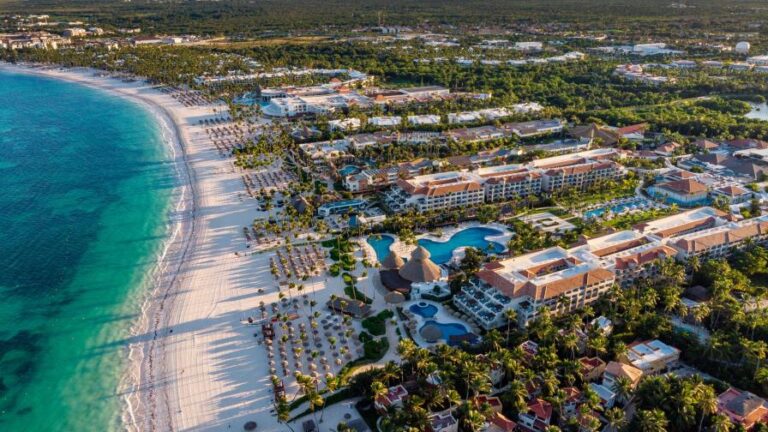

By the end of 2024, the free zone sector in the Dominican Republic solidified its role as one of the fundamental pillars of the national economy. With notable growth in infrastructure, foreign investment, job creation, and exports, this productive model reaffirmed its strategic importance in the country’s economic development. In 2024, free zone exports reached a value of US$8,425.9 million, representing a 5.9% increase compared to the previous year.
Expansion of Industrial Parks and Companies
According to the “2024 Statistical Report” from the National Council of Export Free Zones (CNZFE), the country had 94 operational free zones, an 8% increase from the previous year. The Northern Region hosts 49% of these parks. The National District and Santo Domingo Province account for 21.3%, equal to the Southern Region. The Eastern Region holds the remaining 8.5%.
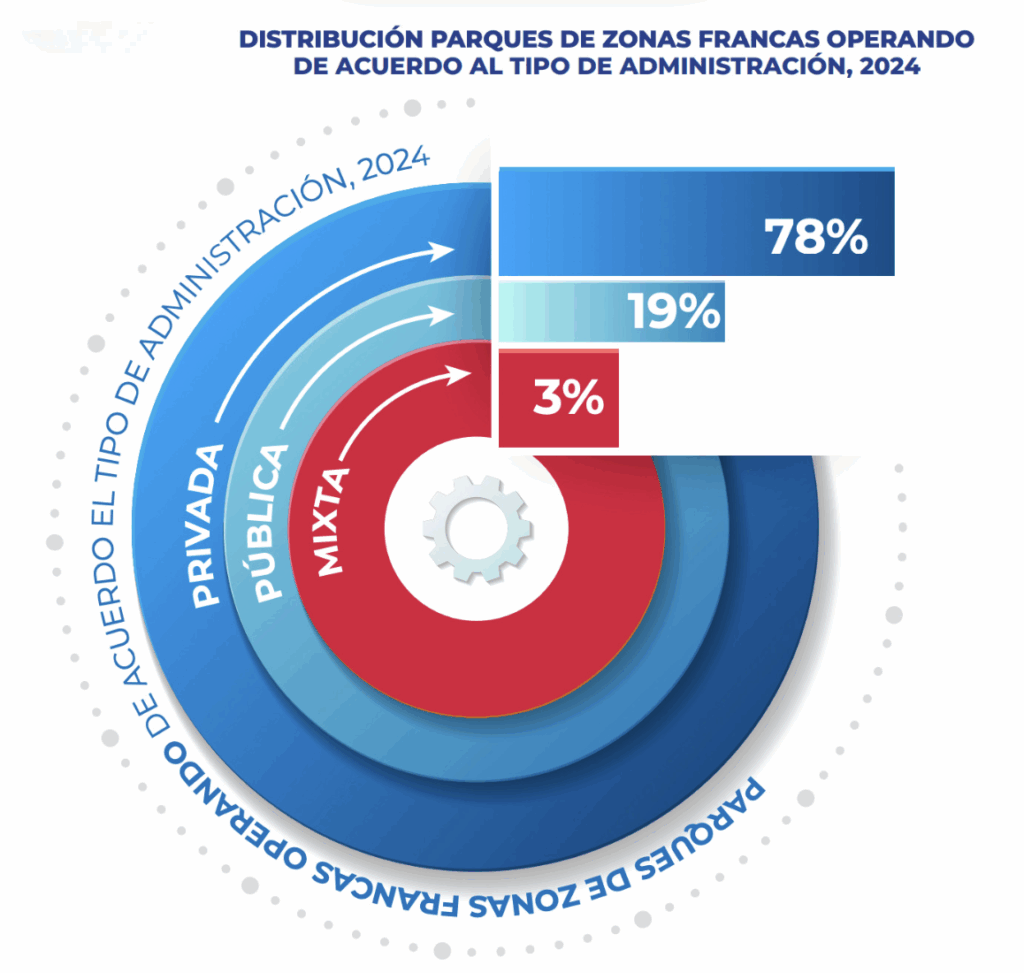
Regarding ownership, 77.7% of the parks are private, 19.1% are public, and 3.2% operate under mixed administration. This distribution reflects strong private sector participation in industrial development.
Additionally, the number of active companies increased. By the end of 2024, there were 843 active firms—2.8% more than in 2023. The majority are located in the Northern Region (49.9%). The National District and Santo Domingo have 25.7%, the Southern Region 14%, and the Eastern Region 10.3%.
Economic Activities and Business Distribution
In terms of location, 52% of the companies operate in private parks. 15.3% are in public parks, 10% in mixed parks, and the remaining 22.8% are in special free zones and service zones.
Regarding economic activities, tobacco manufacturing leads with 19% of the companies. It is followed by Call Center/BPO services (12.7%) and textile clothing (12.5%). Other prominent sectors include general services (11.4%), agro-industrial products (6.8%), and commercialization (5.9%). Other relevant sectors are medical products (4.7%), electronics (3.6%), and stationery (3.4%). The remaining 20% encompasses various activities.
Employment Generation (Direct)
In 2024, the sector generated 198,552 direct jobs. This represents a 0.3% increase from the previous year and marks the highest level in its history. The tobacco industry leads with 39,005 jobs, followed by textile clothing (36,194), Call Centers/BPO (36,043), and medical products (33,437).
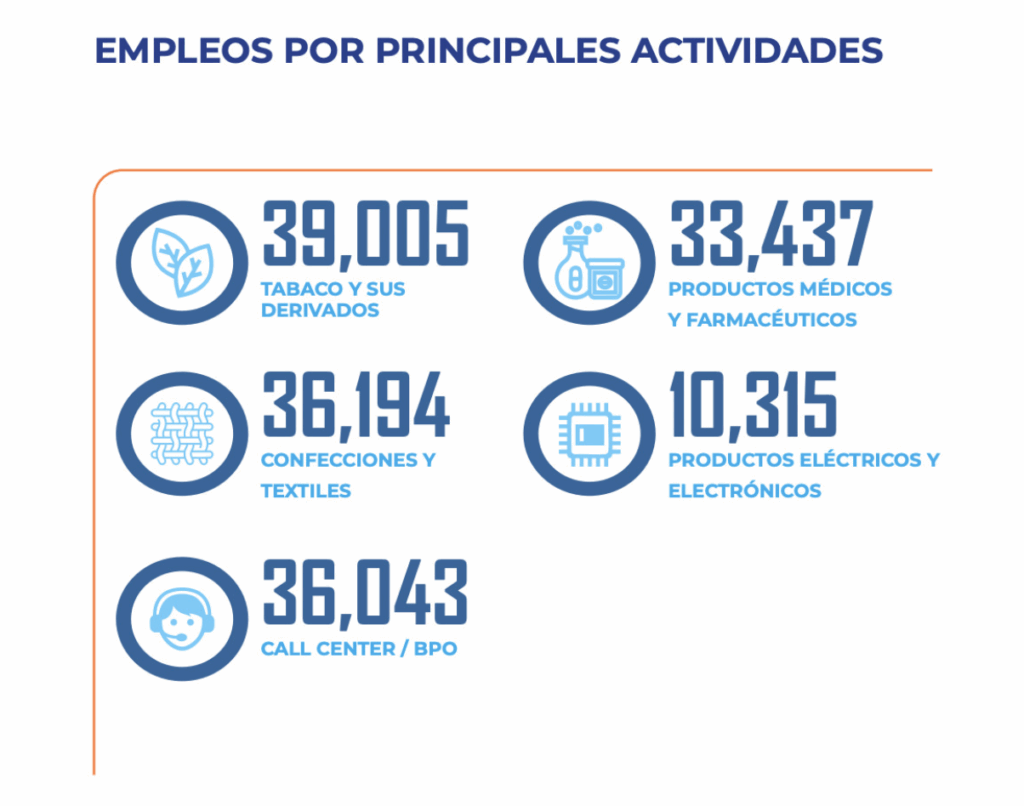
Other sectors include electronics (10,315 jobs), services (7,898), and agro-industry (5,444). The remaining activities account for 30,216 jobs. In terms of location, 56.8% of jobs are in the Northern Region. The National District and Santo Domingo account for 27.3%, the Eastern Region 9.1%, and the Southern Region 6.8%.
Regarding occupations, 63.4% of workers are laborers. Technicians make up 25.3%, and administrative staff 11.3%.
Cumulative Investment and Capital Origin
The accumulated investment in free zones reached US$7,735.7 million in 2024, a 3.2% increase from 2023. The United States leads with 29.8% of the total. The Dominican Republic contributes 24.1%, followed by Germany (9.7%), the United Kingdom (8.5%), and Canada (3.7%).
Other countries with significant participation include Spain (2.8%) and China (2.7%). The remaining 18.6% comes from 49 additional countries.
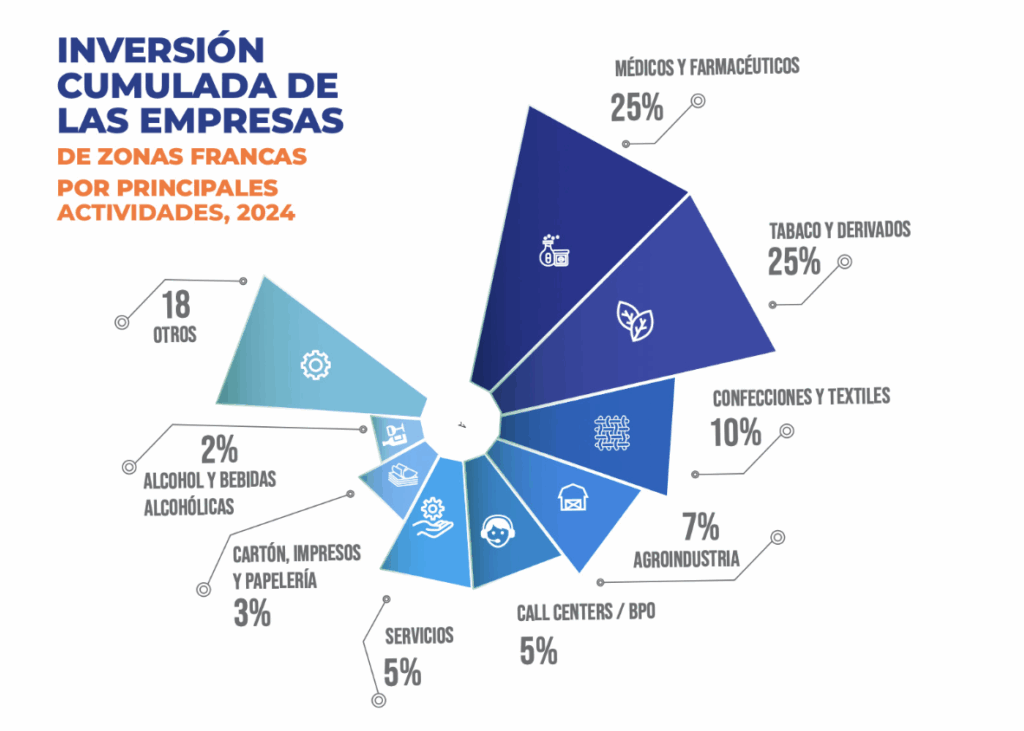
In terms of sectors, medical products account for 25.1% of the investment. Followed by tobacco (24.7%), textile clothing (9.9%), and agro-industry (6.9%). Other notable sectors include call centers (5.6%), services (4.7%), stationery (2.8%), alcoholic beverages (2.6%), plastics (2.5%), and footwear (2.3%). The remaining 12.9% is distributed among other activities.
Exports: Driving Foreign Trade
Free zone exports reached US$8,425.9 million in 2024, a 5.9% increase over the previous year. Consequently, the sector contributed 61% of the country’s total goods exports.
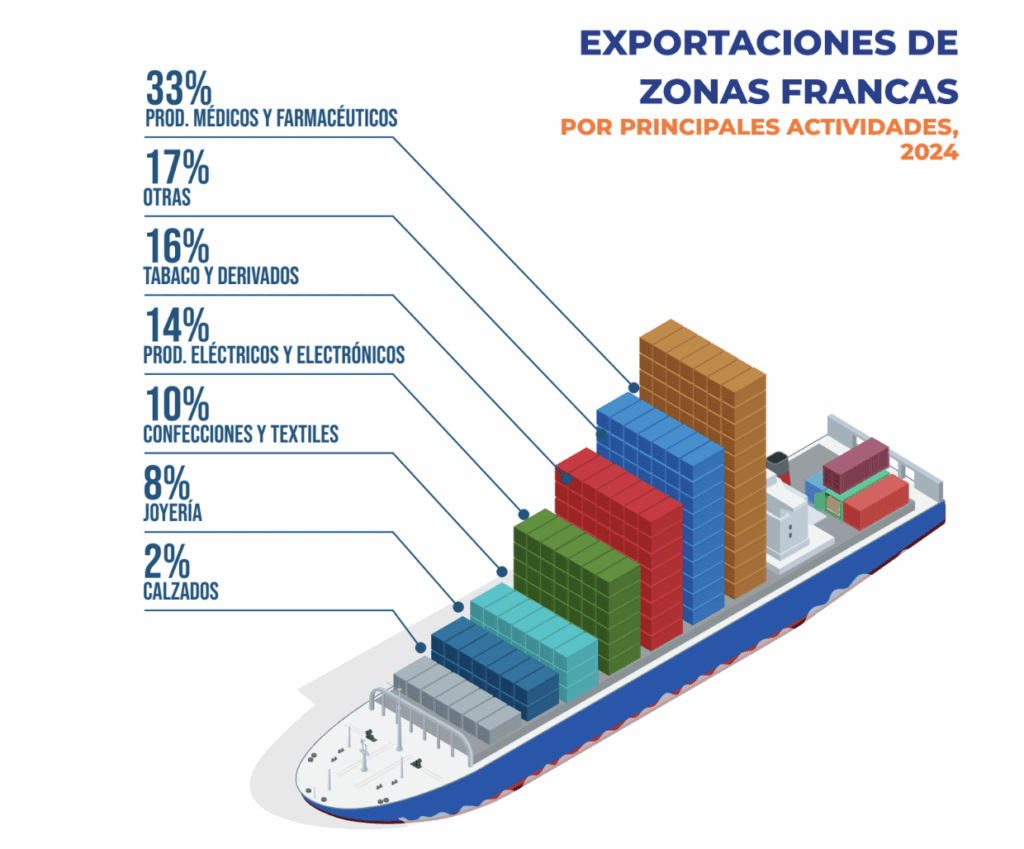
Medical and pharmaceutical products lead with US$2,762.6 million, accounting for 32.8% of total exports. They are followed by tobacco and derivatives (15.7%), electrical products (13.7%), and textile clothing (9.8%). Other key sectors include jewelry (8.5%) and footwear (1.8%). The remaining 17.7% corresponds to other activities.
Local Economic Impact
In addition to its impact on exports, the sector also makes a significant contribution to the local economy. Total spending reached US$2,142.6 million in 2024, representing a 5.7% increase compared to 2023. These expenses include payments for services such as electricity, telecommunications, social security, technical training, and water.
Overall, companies paid RD$23,354.5 million for these services. The majority was allocated to the Social Security Treasury (RD$14,769.7 million). Following that are electricity (RD$6,413.2 million), telecommunications (RD$1,339.8 million), INFORTEP (RD$613.7 million), and water supply (RD$218.1 million).
Source: