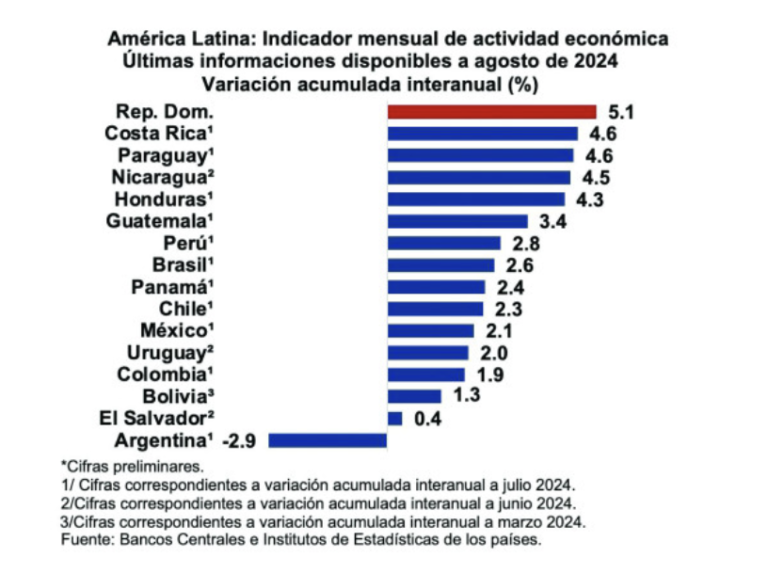

- Regional foreign investment accounted for 44% of GDP, compared with 25% in emerging Asia. Trade accounts for 52% of Latin American GDP, compared with 65% for comparable economies. The IMF estimates that regional exports could increase by as much as 20%.
The challenge for the Dominican Republic to strengthen its exports is not only to sell more abroad, but also to take better advantage of foreign investment to increase productivity, incorporate technology and connect its companies with international markets.
That is one of the main conclusions of the International Monetary Fund’s (IMF) analysis of Latin America and the Caribbean, released on November 9, 2026.
The agency estimates that the region’s exports could increase by up to 20% if countries properly took advantage of the benefits of foreign direct investment.
The proposal raises an important question for the Dominican economy: how to transform the arrival of foreign capital into greater export capacity and a more solid participation in global value chains.
The international organization’s report points out that there is an important difference between Latin America and other emerging economies in the way foreign direct investment is taken advantage of.
In emerging Asia and Europe, a 10% increase in foreign direct investment translates into a 1 to 2% growth in exports. In Latin America, however, this relationship is weaker and harder to identify.
The difference is significant because the region received investments of US$3 trillion in 2024, equivalent to 44% of its gross domestic product (GDP). This proportion exceeded that recorded by emerging Asia, with 25%, and those in Europe, with 21%.
Foreign Investment and Trade Participation: Latin America vs. Other Economies
A comparison of the indicators shows a gap between the weight of foreign investment and the share of trade in the Latin American economy.
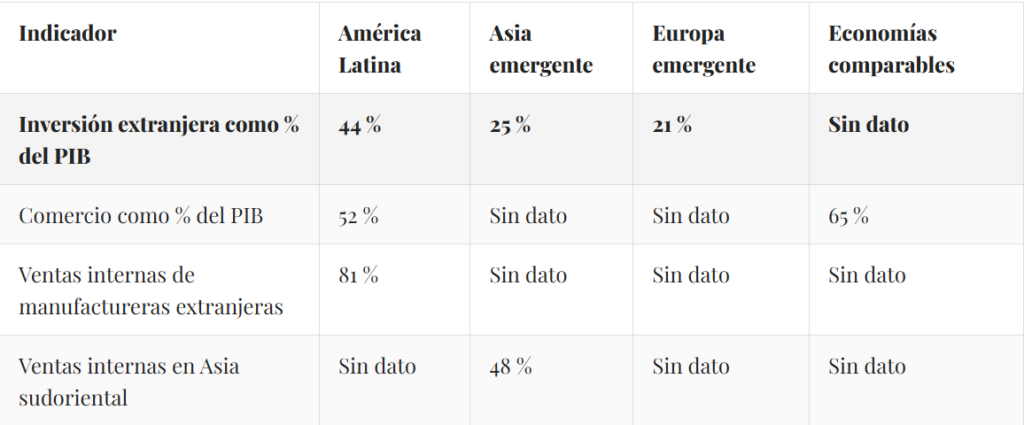
The data reflect that the volume of investment does not necessarily translate into a greater presence of Latin American products in international markets.
The IMF warns that trade accounts for approximately 52% of regional GDP, compared to 65% for comparable economies. This gap shows the room that still exists to strengthen export activity.
Foreign investment: capital alone does not guarantee more exports
For the IMF, foreign direct investment can provide much more than financial resources. Multinational enterprises also introduce technology, know-how, capital, and access to external markets.
However, the use of these advantages depends on the economic and regulatory conditions of each country, as well as on the ability of local firms to incorporate this knowledge and convert it into greater productivity.
The report identifies a particularity of the Latin American model: foreign manufacturing firms typically sell approximately 81% of their output in domestic markets. In Southeast Asia, that share stands at 48%.
This difference helps to understand why high foreign investment does not always produce equivalent export growth.
As for the Dominican Republic, the approach is especially relevant when analyzing the potential of its export sectors, including mining, medical manufacturing, and the tobacco industry. The opportunity lies in ensuring that the investment strengthens its productive capacity and its connection with international buyers.
The debate is also related to the development of Dominican free zones, whose manufacturing activity represents a way to expand the country’s participation in international supply chains.
Source: