

- ECLAC study shows that the country faces the fourth highest average tariff in trade with the US.
Despite facing the fourth-highest weighted average U.S. tariff rate among Latin American and Caribbean countries, the Dominican Republic’s exports are still expected to grow by double digits in 2026.
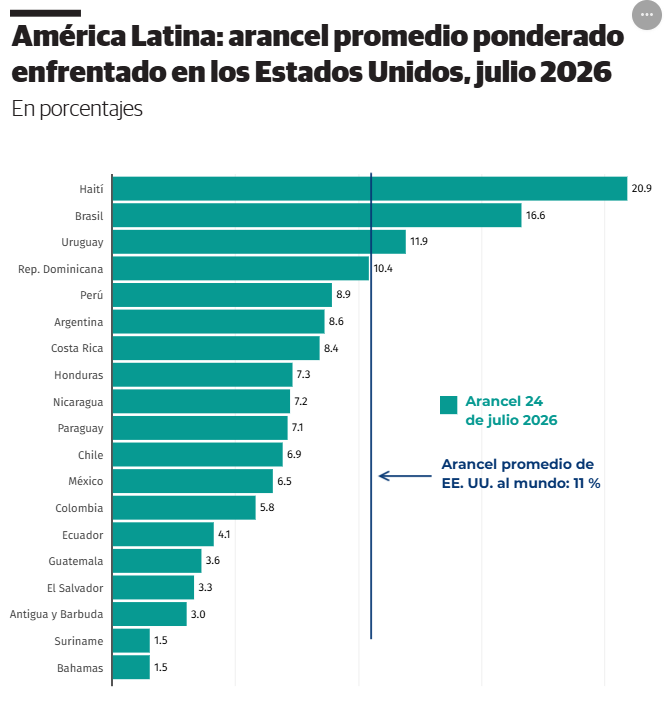
The country faces an average tariff of 10.4% for its exports to the United States, surpassed only by Haiti (20.9%), Brazil (16.6%) and Uruguay (11.9%), but below the average of 11% faced by the rest of the world in its trade with the U.S.
However, the barrier established by the country’s main trading partner will not prevent national exports from growing by 14% this year, according to a study prepared by the Economic Commission for Latin America and the Caribbean (ECLAC), which highlights the “profound reconfiguration that world trade is experiencing”.
The annual report “International Trade Outlook for Latin America and the Caribbean 2026: The Importance of Modern Services Exports and How to Promote Them,” presented yesterday by ECLAC’s executive secretary, José Manuel Salazar, anticipates that the region’s exports will grow, on average, by 20% this year, against this backdrop.
Modern services
The analysis highlights the energy of modern services exports from three small economies in the region, including the Dominican Republic, an issue that Salazar described as crucial for Latin America’s development.
The executive stressed that, although Brazil and Mexico are the main exporters of services in the region, both representing half of exports of this type, with 30,000 and 16,000 million dollars, respectively, it is Costa Rica, Uruguay and the Dominican Republic that show the most vigorous growth.
“Costa Rica and Uruguay lead, with an average annual growth of 16%, followed by Colombia and the Dominican Republic, with 13% each. This contrast suggests that export performance responds not only to market conditions, but also to deliberate policies and institutional capacities that allow smaller countries to climb positions in a sustained manner,” he explained.
The ECLAC executive said that “something we know, both from Costa Rica and Uruguay and from the Dominican Republic, is that they have specific policies and strategies to promote exports of modern services.”
Modern services are defined in two categories: traditional (retail, local transport, construction, personal and household services, hotels and restaurants) and modern services (based on information technology and communications: business, professional, financial, audiovisual, creative, information technology and research and development services).
Suggestions to the DR
While presenting the report, ECLAC’s executive secretary made some recommendations to the Dominican Republic regarding maintaining its performance and economic momentum.
- José Manuel Salazar called on the country to deepen productive development policies, strengthen local chains, continue diversifying exports through modern services, and accelerate the transition to renewable energies.
“The Dominican Republic already has a modern services sector with significant growth potential. It should diversify export markets and sources of investment where possible, pursue more practical regional integration, and prioritize stronger linkages within its economy,” he said.
International trade reconfiguration
ECLAC Executive Secretary José Manuel Salazar presented the report’s findings on international trade in the first half of 2026. Compared with the same period in 2025, U.S. imports fell 24.5% from China and 21.8% from the European Union, while rising 32.1% from ASEAN countries and 11.1% from Latin America and the Caribbean. Salazar said this shift shows the United States reducing direct imports from China in favor of other Asian suppliers. However, because imports from countries such as Vietnam and India contain substantial Chinese inputs, the economic decoupling is less extensive than it appears. Meanwhile, China increased imports by 29.4% from Latin America and the Caribbean and by 21.4% from ASEAN, while the European Union increased imports from Latin America and the Caribbean by 17%. Salazar said these trends position the region as an increasingly dynamic and strategic supplier to the world’s three major economies or trading blocks.
Source:

