- Government announces more than 15,000 scholarships through the Talent Up program.
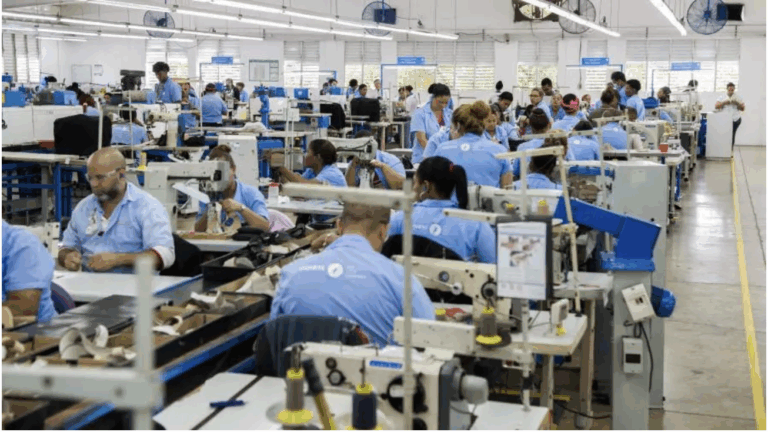
Diversification in the free zone sector has shifted exports toward more advanced industries: eight years ago, textiles accounted for 55% of the export mix; today, advanced manufacturing represents more than 50% of free zone exports.
Minister of Industry, Trade and MSMEs (MICM) Eduardo Sanz Lovatón said that medical devices currently account for 35% of exports, while electronic supplies represent 15%.
“This means that advanced manufacturing accounts for more than 50% of exports. When agro-industrial exports are included, it is clear that our export mix has transformed,” the official said at the “Free Trade Zones, Opportunity Zones” event.
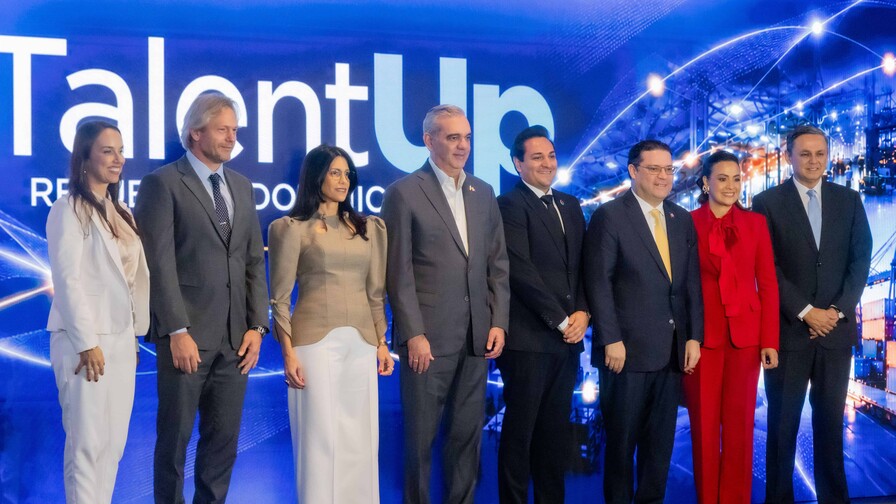
At the event, attended by President Luis Abinader, Sanz Lovatón announced more than 15,000 digital-skills scholarships through TalentUP, supported by the Inter-American Development Bank, Google Cloud, and Cisco.
Sanz Lovatón said the scholarships have already attracted more than 14,000 applications. They will provide young people with free training in emerging technologies, cloud storage, and cybersecurity, preparing graduates to fill companies’ workforce needs.
Free zone growth and its economic contribution
Speaking at the event, Dominican Association of Free Zones (Adozona) chairperson, Claudia Pellerano, said the sector is becoming more diversified and integrated into global value chains.
She said manufacturing growth has been driven by medical devices and electrical and electronic products, alongside traditional goods such as textiles, footwear, tobacco, and rum.
She added that logistics services and contact centers are also key components of the free zone sector.
By the end of 2025, these products and services had contributed $8.5 billion to the Dominican economy and supported more than 200,000 direct jobs across 858 companies.
Free zones therefore contributed value equal to 8.1% of gross domestic product (GDP) last year. “For every peso in free zone tax expenditure, the economy gained 15 pesos in added value,” Pellerano said.
She said the sector’s momentum has continued this year: free zone exports grew 4.4% from January through August 2026, underscoring companies’ resilience amid a complex geopolitical environment.
On track toward the goal
Fernando Ocampo, coordinator of the Inter-American Development Bank’s (IDB) “America at the Center” initiative, said rapid technological advances and artificial intelligence have transformed how industries operate worldwide.
Companies report that AI alone can reduce costs by up to 60%, as global supply chains shift toward nearshoring and friendshoring.
Against this backdrop, Ocampo said the Dominican Republic is on the right path with its RD 2036 Goal strategy, which aims to double the economy’s average growth over the next decade.
He said the TalentUP program will help achieve this goal by sharply narrowing the gap between companies seeking skilled talent and workers preparing for increasingly specialized, demanding roles.
“Specialized talent is the true magnet for investment,” Ocampo said, noting that 87% of executives worldwide view employees with strong digital training as their leading factor for success.
Experts such as Cisco’s Business Development Executive for Latin America and the Caribbean, Caroline Heidrich Seibert, and Google Cloud’s Commercial Director for the Public Sector in Latin America, Gabriel Alvarado, agreed on this, detailing their support for the initiative that seeks to award more than 15,000 scholarships for the training of human talent increasingly oriented towards the use of new technologies and artificial intelligence in a strategic way for companies.
Source: