Cabo Rojo was the fourth port with the highest number of visitors in the first half of 2025.
Cruise tourism continues to evolve as an attractive and relevant offering for international visitors drawn to explore the Dominican Republic.
In the first half of the year, 1,630,915 passengers entered the country via maritime routes, representing a growth of 208.3% compared to the 528,999 cruise passengers who arrived during the entire year of 2015, a year in which the industry saw its most significant boost with the opening of Amber Cove in Puerto Plata, which remains the port with the highest visitor influx to date.
The results show that, in just six months, the country received more than triple the number of cruise passengers it did a decade ago, and up to five times more passengers onboard compared to 2024, a year in which a total of 2,656,305 visitors arrived.
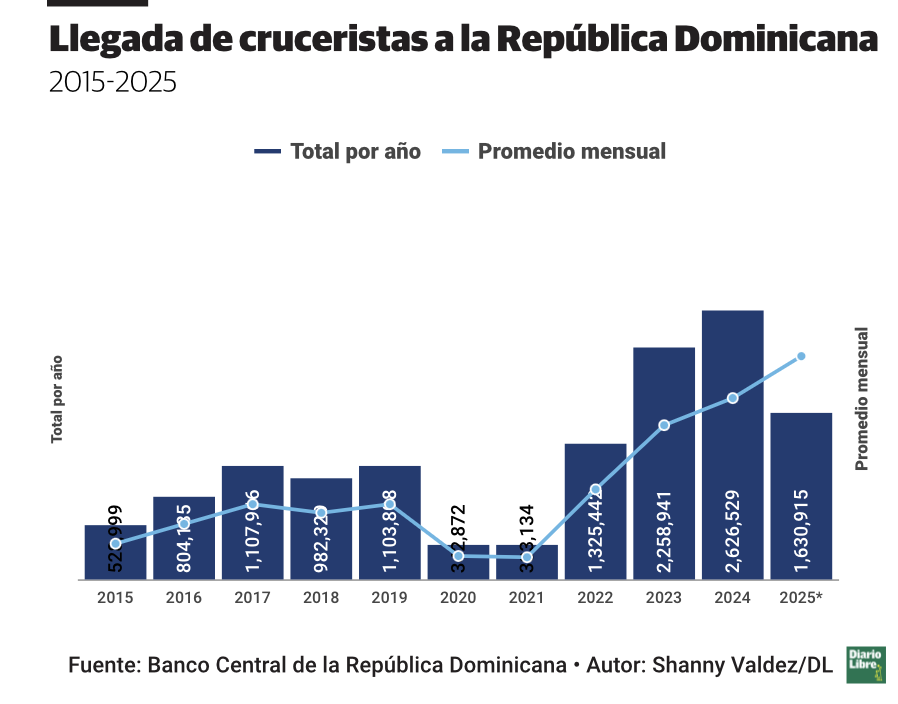
This is shown by data from the Ministry of Tourism and the Central Bank of the Dominican Republic.
In this way, the cruise industry is growing at a rate that has averaged the arrival of 1,188,635 visitors per year over the last decade, driven by the dynamism of Taíno Bay—operating since 2021—and the negotiation of new maritime routes through both well-established ports—such as La Romana—and emerging ones—like Cabo Rojo.
Cruises in Puerto Plata
The increase in cruise offerings in Puerto Plata during the last decade remains unstoppable. During its first year of operations, Amber Cove transported 58,912 cruise passengers, representing 11.13% of the total that disembarked in the country in 2015.
In nine years, that share expanded to 45.22%, with the arrival of 1,201,255 visitors in 2024.
In the first half of this year, 641,845 cruise passengers disembarked at Amber Cove, representing 39% of the total, being surpassed during this period by Taíno Bay.
The second port of the Bride of the Atlantic recorded 189 operations with 646,277 passengers aboard between January and June, leaving far behind the 20,985 cruise passengers that docked there in its first year of operation, 2021.
Both ports handled almost 80% of the cruise visitors that the country received between January and June of this year.
Cabo Rojo in Fourth Place
The scheduling of new maritime routes in Pedernales is already bearing fruit in its new port, inaugurated by the Government at the beginning of 2024.
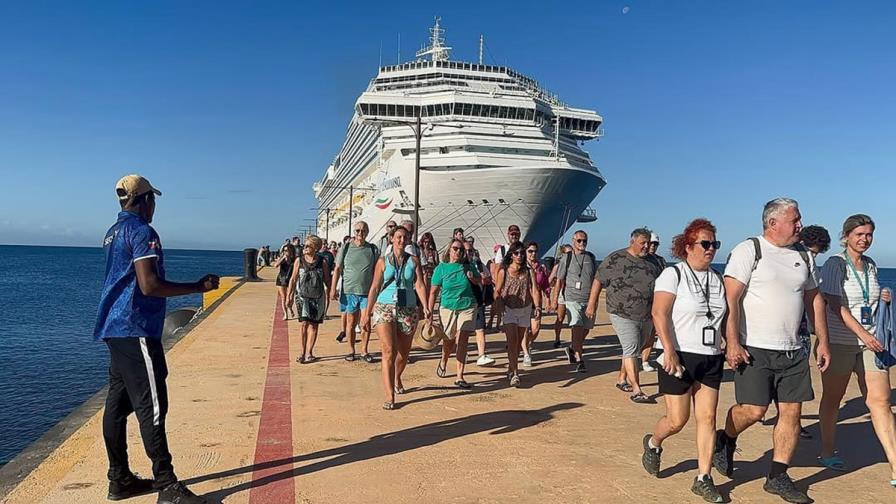
The Cabo Rojo port went from closing the year with 11,626 visitors to finishing the first half of 2025 with 50,261 passengers aboard, marking an important expansion of 332.3%, and placing it as the fourth port that received the most tourists during that period after Amber Cove, Taíno Bay, and La Romana.
A month ago, during the inauguration ceremony of the Arroyo Barril port, the Executive Director of the Port Authority, Jean Luis Rodríguez, projected that Cabo Rojo will close 2025 with the arrival of 150,000 maritime passengers.
La Romana
The La Romana port, which ten years ago was the most visited port in the country, now occupies third place, with growth that has remained steady throughout this decade, averaging 259,865 visitors per year.
The port maintained a 12% share in the local cruise industry during the first half of this year, following the arrival of 203,287 cruise passengers, according to the Ministry of Tourism.
Port operators maintain positive expectations for 2025, following the arrival of British shipping lines that have established new routes after their departure from Barbados, a country that ceased to be part of the British Commonwealth, according to Andrés Fernández, president of the La Romana Bayahíbe Hotels Association.
The executive, who is also the commercial director of the La Romana cruise port, recently announced in an interview with Diario Libre that the Italian cruise line MSC Cruises will also begin moving passengers starting winter 2026, establishing two weekly routes.
In almost a decade, the Dominican Republic has quintupled the arrival of cruise passengers, a segment that has been crucial for Dominican tourism to reach its proposed goals and stand out as a leading industry in the Caribbean.
Source: