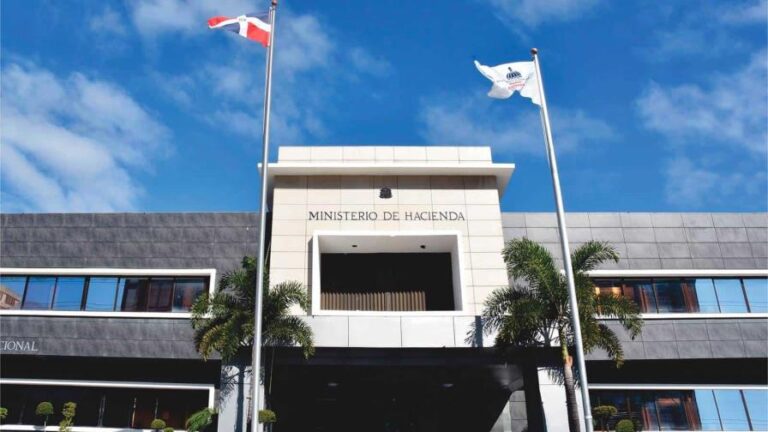
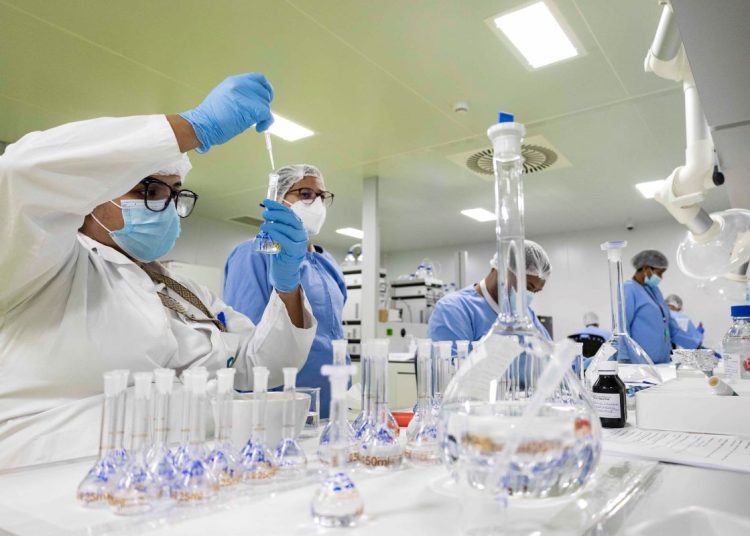
There are currently approximately 261 industries dedicated to the manufacturing of pharmaceutical products, according to a report issued by the Ministry of Industry, Commerce and MSMEs (MICM).
The pharmaceutical industry plays a critical role in advancing public health and fostering economic development. According to data from the Social Security Treasury (TSS), the average number of contributing workers in pharmaceutical manufacturing increased from 9,940 in 2015 to 17,457 in 2024, representing an average annual growth rate of 6.5%.
As highlighted in the recent pharmaceutical sector report published by MICM, this activity accounted, on average, for 4.7% of total formal employment within the manufacturing sector.
The report notes a particularly strong expansion in 2022, with employment growing by 14%, primarily driven by a 15.6% increase in the sub-activity “manufacture of medicines for human use and pharmaceutical products.”
Citing figures from the General Directorate of Internal Revenue (DGII), the report indicates that fiscal contributions from pharmaceutical manufacturing in the Dominican Republic grew at an average annual rate of 13.4%, rising from DOP 1.58 billion in 2015 to DOP 4.90 billion in 2024.
However, when comparing collections between 2023 and 2024, a decline of 11% was observed, decreasing from DOP 5.51 billion to DOP 4.90 billion.
As of July 2024, the DGII identified 261 industries engaged in pharmaceutical manufacturing, of which 95.4% operate under the local manufacturing regime and 4.6% under the special regime established by Law 8-90 on Free Trade Zone Development.
Regarding tax domicile distribution, the economic profile of the pharmaceutical manufacturing sector as of October 2025 indicates that 73.2% of these industries are located in the metropolitan area (Greater Santo Domingo); 22.6% in the Cibao region; 2.7% in the Eastern region; and 1.5% in the Southern region.
At the provincial level, 45.2% of these industries are registered in the National District; 28.0% in Santo Domingo province; 18.4% in Santiago; 1.9% in Espaillat; and 6.5% across the remainder of the country.
Source: