
- Leader in the Caribbean: ECLAC places the Dominican Republic among the fastest growing economies in Latin America
The Dominican Republic is emerging as one of the most dynamic economies in Latin America and the Caribbean in 2026 and 2027.
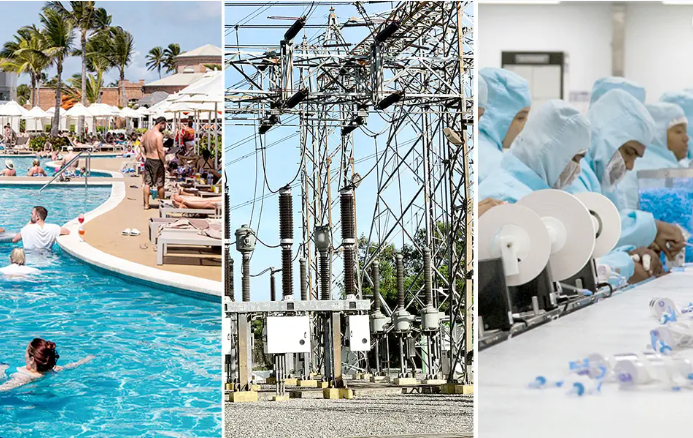
The Economic Commission for Latin America and the Caribbean (ECLAC) forecasts that the country will grow 4.0% in 2026 and accelerate its expansion to 4.4% in 2027, driven mainly by tourism and services.
The estimate places the Dominican Republic in a prominent position within the Caribbean and above the average growth forecast for Latin America and the Caribbean, which will be 2.2% in 2026 and 2.5% in 2027.
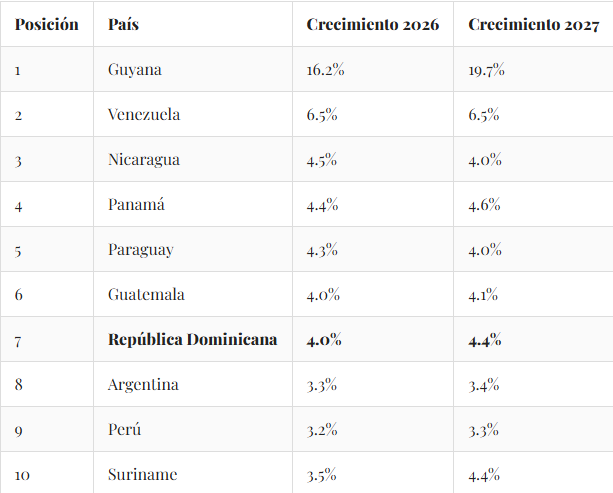
The regional panorama, however, presents strong contrasts. While Guyana will lead growth with rates of 16.2% in 2026 and 19.7% in 2027, Cuba will face the largest contraction, with falls of 10.3% and 5.1%, respectively.
Dominican Republic Stands Out Among Fastest-Growing Economies
ECLAC’s new projection places the Dominican Republic among the countries with the best economic performance in Latin America, especially within the Caribbean.
The organization attributes part of this strength to the vitality of tourism and services, sectors that maintain a relevant weight in Dominican economic activity. With growth expected at 4.0 percent this year and 4.4 percent next year, the country would far exceed the regional expansion forecast for both periods.
The Dominican performance is also relevant when compared to other Caribbean economies. Antigua and Barbuda would grow 3.5% in 2026 and 2027, while Grenada would have rates of 3.5% in both years. Dominica would advance 3.1% in 2026 and 2.8% in 2027.
In this scenario, the Dominican Republic appears as one of the Caribbean economies with the fastest rate of expansion, although still well below the extraordinary growth recorded by Guyana due to the boom in its oil production.
Guyana leads growth and Cuba faces a sharp decline
The contrast within the region is particularly stark. Guyana will be the fastest growing economy in Latin America and the Caribbean, according to ECLAC’s update. Its gross domestic product will increase 16.2% in 2026 and 19.7% in 2027, driven by the development of its oil industry.
As for South America, Venezuela also stands out with a projected expansion of 6.5% in 2026 and 6.5% in 2027. Paraguay will grow 4.3% this year and 4.0% next year, while Argentina will reach 3.3% and 3.4%, respectively.
In Central America, Panama registers one of the best prospects, with an estimated growth of 4.4% in 2026 and 4.6% in 2027. Nicaragua will expand by 4.5% and 4.0%, while Guatemala will grow 4.0% and 4.1%.
Cuba finds itself at the opposite end of the scale. ECLAC calculates a contraction of 10.3% in 2026 and 5.1% in 2027, the worst outlook among the economies analyzed. Haiti will also register setbacks, while Jamaica will fall 1.2% in 2026 before recovering growth of 2.5% in 2027.
Regional growth remains constrained by low investment and productivity
Although the figures for the Dominican Republic are favorable, ECLAC warns that growth in Latin America still not enough to sustainably raise per capita income and reduce development gaps.
The region will grow 2.2% in 2026, following a 2.4% expansion in 2025. By 2027, a partial recovery of up to 2.5% is expected. The organization considers that the outlook is conditioned by a more complex international scenario, with lower global growth, geopolitical and financial uncertainty, and pressures on energy markets.
ECLAC also identifies structural problems such as low levels of investment, low productivity growth, casual labor, and a slowdown in formal job creation.
For the Dominican Republic, the 4.4% forecast for 2027 represents an opportunity to hold its position among the most energetic economies in the region. However, the challenge will be to transform that growth into higher levels of productivity, formal employment, and well-being.
Therefore, while Guyana sets an exceptional pace thanks to oil, the Dominican Republic stands out for a more balanced growth, supported by tourism and services, consolidating itself as one of the main economic engines of the Caribbean over the next two years.
Source: