

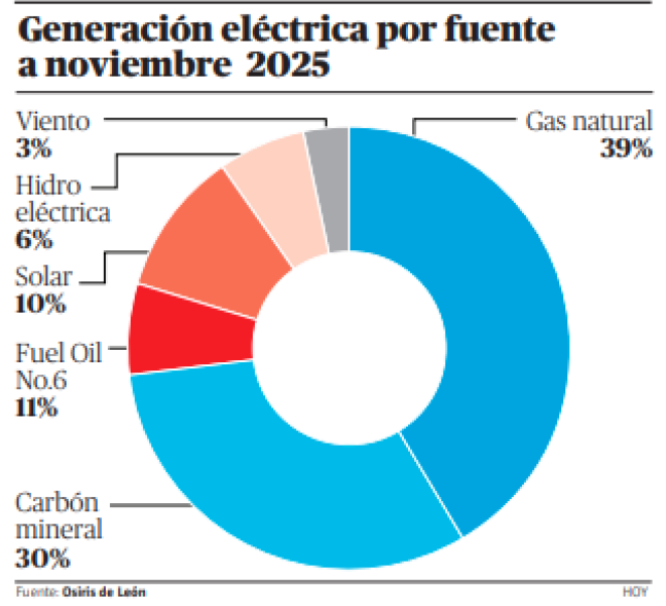
- De León highlighted that the use of fuel oil has dropped from 99% in the 1970s to just 11% in 2025, while hydroelectric capacity has increased from 15 to 624 megawatts.
With the inauguration last Friday of the largest photovoltaic complex in Central America and the Caribbean, the Dominican Republic continues advancing toward an energy matrix increasingly powered by renewable sources, which already account for 25% of total generation. Solar energy alone currently exceeds 10%.
The Cotoperí Solar complex is located in Guaymate, La Romana, with a generation capacity of 162.6 megawatts. Its three plants will produce 286 gigawatt-hours per year of clean energy, supplying 95,000 households and preventing the emission of 210,000 tons of CO₂.
When consulted about the evolution of the energy matrix, geologist Osiris de León emphasized that the use of fuel oil has declined from 99% in the 1970s to just 11% in 2025, while hydroelectric capacity has expanded from 15 to 624 megawatts over the same period.
He detailed that until the 1970s, the matrix depended primarily on fuel oil and diesel, as the only hydroelectric plants were Jimenoa, built in Jarabacoa in 1954 with a capacity of just 8.4 MW, and Las Damas in Duvergé with 7.5 MW.
However, in 1974 and 1975, with the construction of the Tavera dam in Baitoa, Santiago (96 MW) and Valdesia in San Cristóbal (54 MW), the country began its path toward high-capacity hydroelectric units. The largest producers today include Jigüey with 98 MW, Aguacate with 60 MW, Monción with 52 MW, Pinalito with 50 MW, and Río Blanco with 25 MW. “As a result, during 2025 the hydroelectric plants, with a total installed capacity of 624.5 MW, have produced 1,345 gigawatt-hours (GWh) of clean energy.”
De León noted that the months with the best performance have been May through November, due to heavy rainfall caused by storms and tropical waves such as the recent Melissa.
“This is why cleaning the reservoirs of the dams is so important, as is already being done in Las Barías, Valdesia, and Hatillo. The sediments accumulated during storms and hurricanes over the past 50 years have filled the reservoirs with millions of cubic meters of material, in some cases reducing storage capacity for aqueducts, irrigation canals, and hydroelectric generation by half. Cleaning will restore their original water capacity, which will in turn increase energy production.”
He added that through the end of last November, natural gas has been the leading energy source, contributing 8,280 gigawatt-hours—representing 39% of total generation—followed by coal with 6,350 GWh, or 30%.
Source: