- Speaking at the 79th anniversary of the Central Bank, real GDP accumulated growth of 4.6% and forecasts point to an expansion of around 4.5% by the end of 2026.
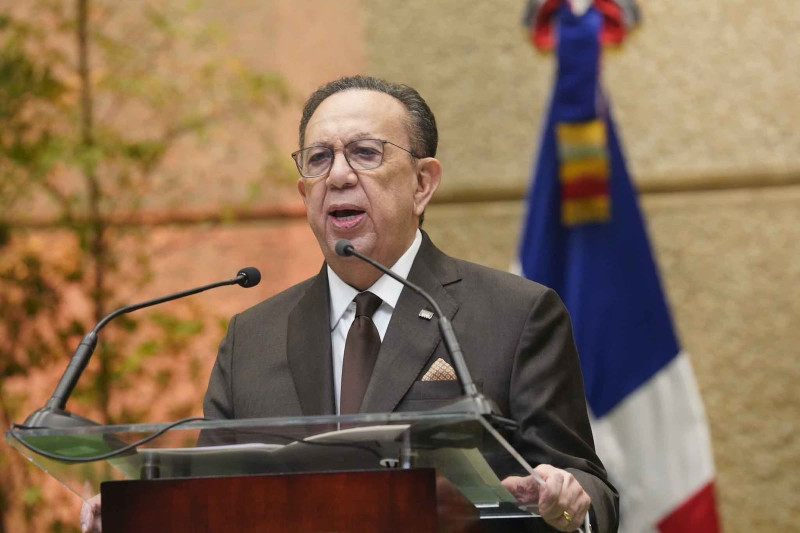
The governor of the Central Bank of the Dominican Republic (BCRD), Héctor Valdez Albizu, highlighted domestic economic growth despite prevailing adverse conditions internationally, with a monthly economic activity index (IMAE) at 5.6%, accumulating 4.6% in January-September 2026.
Speaking at the bank’s 79th anniversary, Valdez Albizu pointed to the energy of domestic investment and the resilience of the external sector.
He revealed that the construction industry contributed 8.2% to this growth, driven by private investment projects, as well as civil engineering works linked to the execution of government capital spending.
Other sectors such as mining and quarrying registered 5.2%, local manufacturing 3.4%, free zones 2.8%, and service activities as a whole 4.6%, highlighting financial services 7.8%, hotels, bars and restaurants 5.6%, and other services 5.4%.
Valdez Albizu explained that tourism was driven by the recovery of source markets, the strengthening of commercial alliances, and greater air connectivity due to the arrival of some 9.2 million tourists during January-September.
As a result, some US$9.7 billion in tourism revenues and more than US$9.4 billion in remittances were captured.
Referring to the labor market, the governor relied on the National Continuous Labor Force Survey (ENCFT) figures, exalting that, in the second quarter of this year, total employment reached 5,271,005 workers, for a year-on-year growth of 2.9%, some 147 thousand new jobs.
“These results show that informal employment stood at 53.8%, below the Latin American regional average. The open unemployment rate stood at 5.3% in April-June 2026, lower than the average of 6.0% in the historical series,” he said.
As for monetary poverty, the economist commented that it has been reduced to 13.57% in the second quarter due to the increase in the wage income of Dominican households.
Exports
Preliminary figures for January-September underline that total exports amounted to about US$13.2 billion, where free zones and national exports exceeded US$6.5 billion.
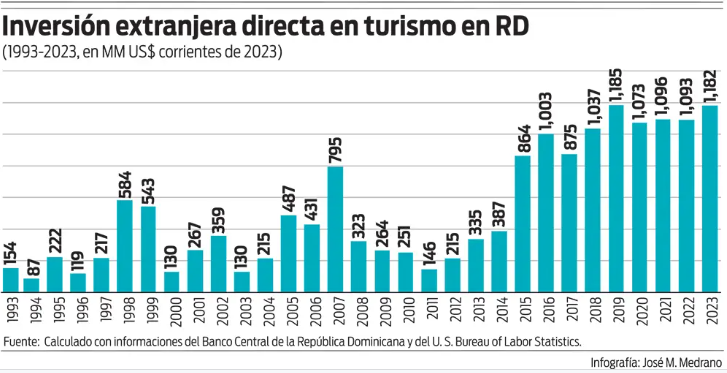
Foreign direct investment registered about US$4,500 million, mainly in sectors such as energy, tourism and real estate, evidence of investor confidence in the country.
These sources of foreign currency contribute to the relative stability of the exchange rate, with an appreciation of the Dominican peso of 5.4% at the end of September.
Financial system
Valdez Albizu said that, thanks to the levels of capitalization, profitability and solvency, the financial system reflected efficient management, where assets amounted to more than RD$ 4 trillion, growing 10.7% year-on-year; equity expanded by 14.4%.
Likewise, return on equity (ROE) was 23.1% and return on assets (ROA), 2.9%, while non-performing loans stood at 1.5%, down from 1.9% observed in September 2025.
The payment system had 39.1 million transactions processed in the real-time gross settlement system in September for an increase of 18.0% compared to 2025.
” 37.1 million of these transactions correspond to the Instant Payments service, used by customers of financial intermediation entities for fund transfers and loan and card payments, both in national and foreign currency,” Valdez Albizu continued.
New payment platform
He took advantage of the occasion to announce that, in 2027, the country will have an instant payment platform, which will operate 24/7 365 days a year, with fund accreditation in seconds and the participation of financial intermediation entities regulated by Monetary and Financial Law 183-02.
The entity will present details of its operation and use later.
Outlook for the end of 2026
At the end of the year, the governor expects inflation to return to the target range in the last quarter of the year, conditioned by the risks from the international environment and the effects of the weather on agricultural production remaining limited. Additionally, economic activity is expected to expand by around 4.5%.
The national economy is expected to close 2026 at around US$50,700 million, with remittances of around US$12,600 million, total exports of more than US$17,200 million, tourism revenues of around US$12,200 million and foreign direct investment flows of about US$5,300 million.
The latter would cover approximately four times the current account deficit of the Balance of Payments, forecast at 1% of the Gross Domestic Product (GDP).
Source: