

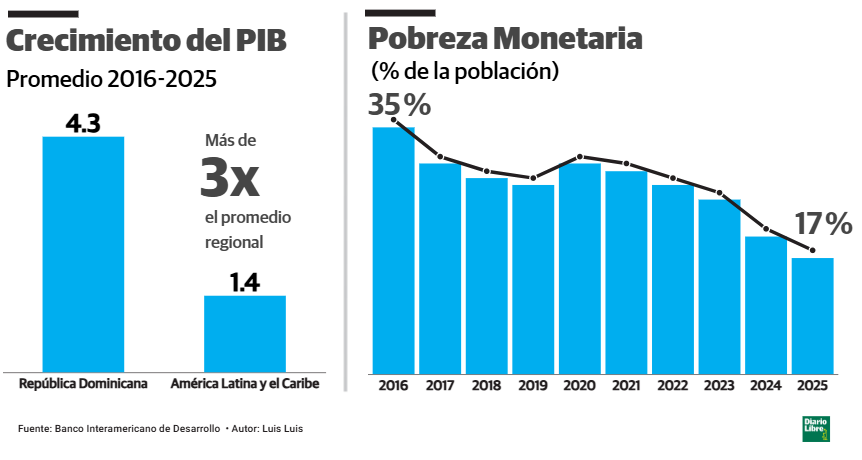
The Dominican Republic has grown three times faster than any other country in Latin America and the Caribbean, showing an expansion of 4.3% between 2016 and 2025 and a 6% increase in capital investment – 88% encouraged by the private sector. Even so, increasing productivity and closing gaps in infrastructure, human talent or governance continue to be among the most pressing tasks to guarantee development.
Representatives of the Inter-American Bank (IDB) and the World Bank (WB), Nathalie Alvarado and Carolina Rendón, respectively, agreed on this, and believe that both the authorities and the private sector should promote competitiveness through an inclusive and sustainable development model.
Alvarado believes that the middle-income trap, the territorial concentration of production in two poles – Santo Domingo and Santiago – and the lack of specialized human talent demanded by companies are among the main constraints on the country’s economic growth.
She said that the country can learn from other country’s experience that overcame the middle-income trap with a commitment focused on productivity, innovation and human capital. “I believe that the Dominican Republic is at that critical moment and can make the leap to the next stage,” he observed.
We need to work on closing gaps that haven’t been overcome
Structural gaps
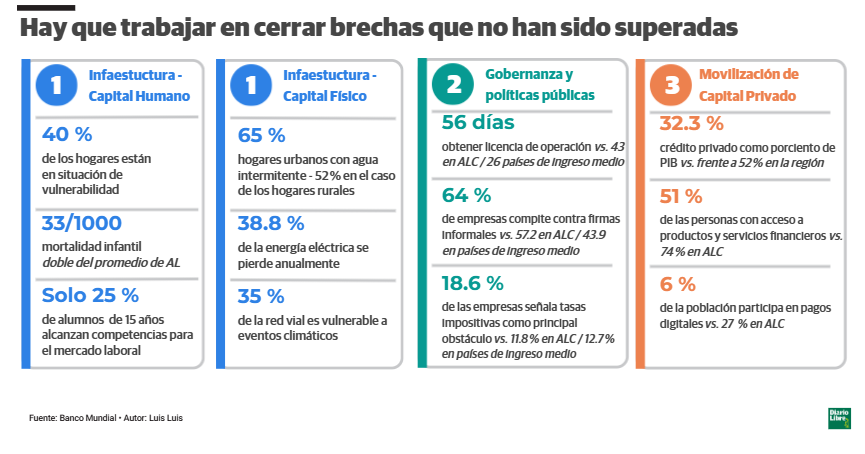
Although the IDB pointed out how economic growth made it possible to reduce monetary poverty from 35% in 2016 to 17% in 2025, the World Bank recalled that 40% of Dominican households are still in a precarious situation, while 35% of the road network is at risk of deterioration due to climatic events.
Furthermore, 65% of urban households and 52% of rural households have intermittent access to water, in addition to a deficient electricity system that sees losses of up to 38.8% each year.
Despite the country’s economic growth, these are just a few examples of how structural gaps persist, affecting productivity and people’s quality of life.
“This progress, this success story in the Dominican Republic has left gaps, some of them significant,” said the country’s WB representative, Carolina Rendón.
Added to this are barriers in terms of governance and public policies.
According to World Bank data, 18.6% of Dominican companies find that tax rates hinder their expansion, some 6.8 percentage points more than the 11.8% average in Latin America and the Caribbean, while 64% of companies compete with informal businesses, much higher than the average of 57.2% in the region.
However, there are also limitations in terms of private capital mobilization.
While 74% of the Latino and Caribbean population has access to financial services and 27% makes digital payments, access in this country is only 51%, and digital payments are used by a mere 6% of the total population.
Therefore, both executives maintained that the country must focus its efforts on continuing to consolidate the economic pillars that have allowed its growth such as construction, tourism, and manufacturing.
They also reiterated that developing new economic engines capable of generating quality jobs, increasing human resource training, and raising productivity and competitiveness for the future such as health, electronics, modern services and agribusiness must be encouraged.
Target 2026, a successful policy
Alvarado and Rendón praised the long-term perspective agreed between the Government and the private sector in the RD Meta 2036 project.
“Few countries have made a long-term vision with clear objectives; the strategic question here is where to concentrate these efforts to accelerate the impact and, above all, maximize the results,” Alvarado pondered.
Rendón observed that the goals set by the Government in December 2024, including raising GDP per capita, doubling exports, expanding the middle class, and improving the quality of life for the next ten years, are valid, challenging, and necessary.
However, this implies improving people’s training skills, guaranteeing quality jobs, and ensuring clear rules of the game for companies to help create these jobs, thus increasing competitiveness.
Although the Executive Branch enacted Law 30-26 on Measures for Economic Growth, Fiscal Simplification and Mitigation of the International Crisis, six days ago, a tool aimed at collecting up to 50,000 million pesos through the correction and elimination of some taxes, both executives refrained from offering their views on how successful they find the measure in the current situation.
Fiscal and budgetary framework
Alvarado and Rendón were the guest speakers at the luncheon held yesterday by the American Chamber of Commerce (Amchamdr). In welcoming them, the president of the Board of Directors of the guild, Francesca Rainieri, recalled how the country has demonstrated the capacity to attract investment, with the challenge of continuing to consolidate these advances, strengthen competitiveness and ensure that growth continues to generate more opportunities.
She assured that the recent discussions on strengthening the country’s fiscal and budgetary framework “should be seen as part of a broader conversation about the development model that the Dominican Republic aspires to build,” while promoting a fiscal model that collects more and more efficiently, while maintaining confidence in it.
Source: