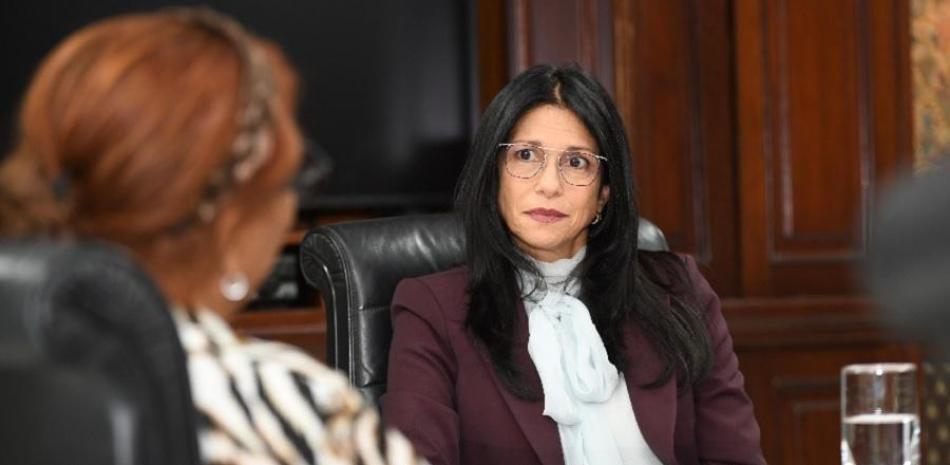
- In Listín Diario interview, Claudia Pellerano highlights the growth of the industrial free zone sector, where she discussed the ongoing transformation and diversification of activities and its support for formal employment.
The free zone sector has evolved comprehensively, supported by hi-tech processes and the diverse tasks carried out in the 97 industrial parks operating in the Dominican Republic.
President of the Dominican Association of Free Trade Zones (Adozona), Claudia Pellerano, highlighted how textile manufacturing in the Dominican free zones has greatly advanced, and that exports ranging from medical devices and vehicle parts, to agro-industrial products and robotics have earned the country a great endorsement.
In an interview with Listín Diario, Pellerano also said that free zone industrial processing goes beyond the exported value seen in the Central Bank statistics and, has therefore asked the monetary policy regulator to review data from the services area, which they estimate to be higher.
Measuring the Sector’s Economic Contribution
Because imported inputs are excluded, the figure reflects the free zone sector’s net contribution to the Dominican economy. Pellerano said that while this contribution is significant, current Central Bank measurements do not yet include services—an area Adozona has asked the institution to incorporate.
The country’s export processing zones include about 850 companies located across the Dominican Republic. Together, they employ more than 200,000 Dominicans.
Women account for 54% of the sector’s workforce, a share linked both to the industry’s roots in textile manufacturing and to women’s growing role in higher value-added production.
In the case of high value-added jobs, such as with medical devices, many of these tasks are carried out by women, Pellerano said.
The percentage of women in the medical device sector, for example, is close to 62% and in some cases up to 65%, said the president of Adozona.
Women have also managed to insert themselves in areas of supervision, management and other types of companies with much more demanding requirements from the point of view of technology and training.
The president of Adozona explained that in the industrial parks there are manufacturers who come from abroad, but together with the Government and academia, they aim to add sustainability to the industry, based on the country’s competitiveness and the integration of service companies aligned with that objective, including logistics companies, construction, and other service areas.
According to the president of Adozona, the sector contributes not only by outsourcing other companies to provide certain services such as transport, catering, suppliers in general, but also academic solutions that promote the development of talents.
“In other words, when we come to see there is a link, there is a local productive chain, as we call it, of suppliers, packaging, suppliers of many elements that are not necessarily provided by the parent company or the international company. And that is the important thing about the free zone sector, that although the companies are international, the effect they have locally is very important,” he said.
Last year’s exports made via the free zone sector are estimated at US 8,600 million, and if US$1,000 million more is added, that is significant, she said.
Diversification
The free zone sector is advancing its ongoing diversification. Moving from traditional manufacturing to higher value-added manufacturing in subsectors has been the result of Dominican talent and its ability to adapt within levels of complexity. Pellerano went on to say this is the reason why the sector is focusing on areas it wants to enhance and is laying the ground in both infrastructure and in maritime, air and telecommunication interconnectivity,
The agribusiness is also undergoing change in production methods, products such as melon or cigars and others. In the automotive industry, car parts are being made, as well as components that control the electrical part in vehicles, which allows preparing personnel in automotive and in the electrical area.
“That is why I always call on the person to think that this evolution of us has nothing to do with the final product, it has to do with what type of processes we are doing locally and what type of process our employability and our talent is capable of addressing. And that is key for when it comes to training talent,” she said.
In this regard, she highlighted the joint actions carried out in technical and professional training, especially in STEM training, which involves science, technology, engineering and mathematics, and then move from one link to the other, because in the case of semiconductors you have to complete the ATP, which are assembly, testing and packaging and, to do so, you need to have elaborate technical knowledge and highly specialized infrastructures.
In addition to heart pacemakers, catheters, and a wide variety of items, Pellerano revealed that neurological and auditory implants are being produced in the country. In other words, to certify, we are really reaching the highest levels of FDA complexity and requirements.
Diamond jewelry is also produced, and Tiffany’s brand is present.
Learn More
The president of Adozona indicated that the salary in companies in the sector is defined as a comprehensive remuneration, because it includes production incentives and other areas such as health, transportation, lunch, since a large number of companies subsidize the lunch.
She also said that international institutions are not just focused on reducing their costs, but also where they can operate in the most efficient manner, complying with all international requirements, including the environmental, human, and social aspects. “So, they are very much geared around sustainable development goals,” he added.
They are also focused on the use of renewable energy, water treatment, and recycling and waste management, separately.
Source: