
- Construction, free zones and manufacturing drove August growth of 3.8%, according to the BCRD.
The monthly indicator of economic activity (IMAE) grew an average of 4.5% from January through August 2026, up from 2.3% in the same period a year earlier, according to preliminary figures released Monday by the Central Bank of the Dominican Republic (BCRD).
In August, the IMAE rose 3.8% year over year, led by higher real value added in construction (7.9%), free zone manufacturing (3.4%) and local manufacturing (3.1%).
Services grew 4.1% overall, led by financial activities (9.4%), education (6.1%), energy and water (6.0%), and other market services (6.0%).
Transportation and storage (3.7%), commerce (3.2%), public administration (3.1%), health (2.8%), professional services (2.7%), communications (2.6%), and hotels, bars and restaurants (2.3%) also posted gains. Mining (-14.6%) and agriculture (-1.4%) declined.
Construction growth was driven by private residential and nonresidential projects and by civil engineering works tied to government capital spending, boosting sales of key sector inputs and materials.
Institutional reforms that have made approvals for new projects faster and more transparent also supported the sector’s performance.
Construction credit also stood out, rising 16.2% year over year at the end of August—more than 26,000 million pesos above the same period a year earlier.
Manufacturing and tourism
Free zone manufacturing grew year over year in August, supported by strong exports of tobacco, jewelry and related articles, and electrical products.
Local manufacturing grew a moderate 3.1%, supported by nonmetallic mineral products, chemicals and pharmaceuticals, according to the BCRD.
Mining contracted 14.6% year over year in August, mainly because scheduled maintenance at the country’s principal plant reduced gold extraction. Even so, the sector grew 3.6% from January through August 2026.
Growth in hotels, bars, and restaurants in August was driven mainly by an increase in nonresident air arrivals.
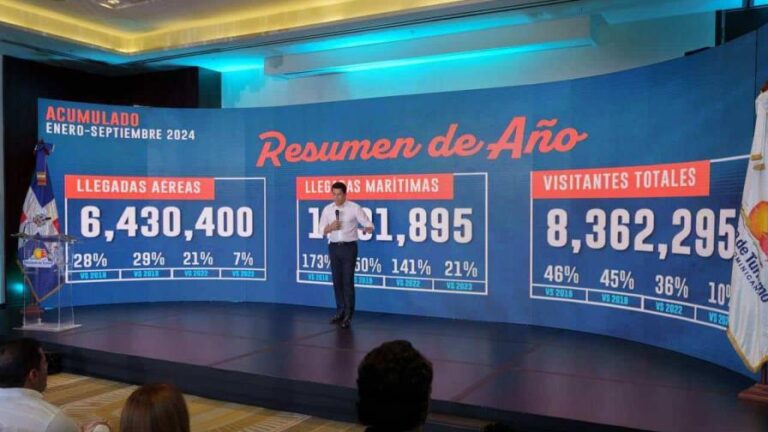
The country received 725,481 tourists in August, 2.6% more than in August 2025. From January through August 2026, international arrivals through all airports totaled 6,610,506, an 8.6% increase from the same period a year earlier.
This performance reflects Ministry of Tourism promotion strategies designed to strengthen the country’s presence in key source markets and diversify visitors’ countries of origin.
Financial intermediation, insurance and related activities grew 9.4% year over year, driven mainly by higher commissions from foreign exchange transactions, credit cards, money orders, transfers, guarantees and other services.
The insurance sector’s performance and a 7.6% nominal increase in private-sector credit in domestic and foreign currency—187,000 million pesos more than in August 2025—also contributed to the month’s result.
Agriculture
Agriculture’s real value added fell 1.4% year over year in August 2026, largely because drought affected several regions of the country in recent months.
Reported production of rice, legumes, tubers, pigs and other products declined from the same month a year earlier. As a result, agriculture grew 1.9% from January through August 2026.
The January–August 2026 result aligns with the roughly 4.5% growth projected in the macroeconomic framework agreed by the Ministry of Finance and Economy and the Central Bank. If achieved, it would far exceed the International Monetary Fund’s 2.4% average forecast for Latin America this year and more than double the growth recorded in 2025.
Source: